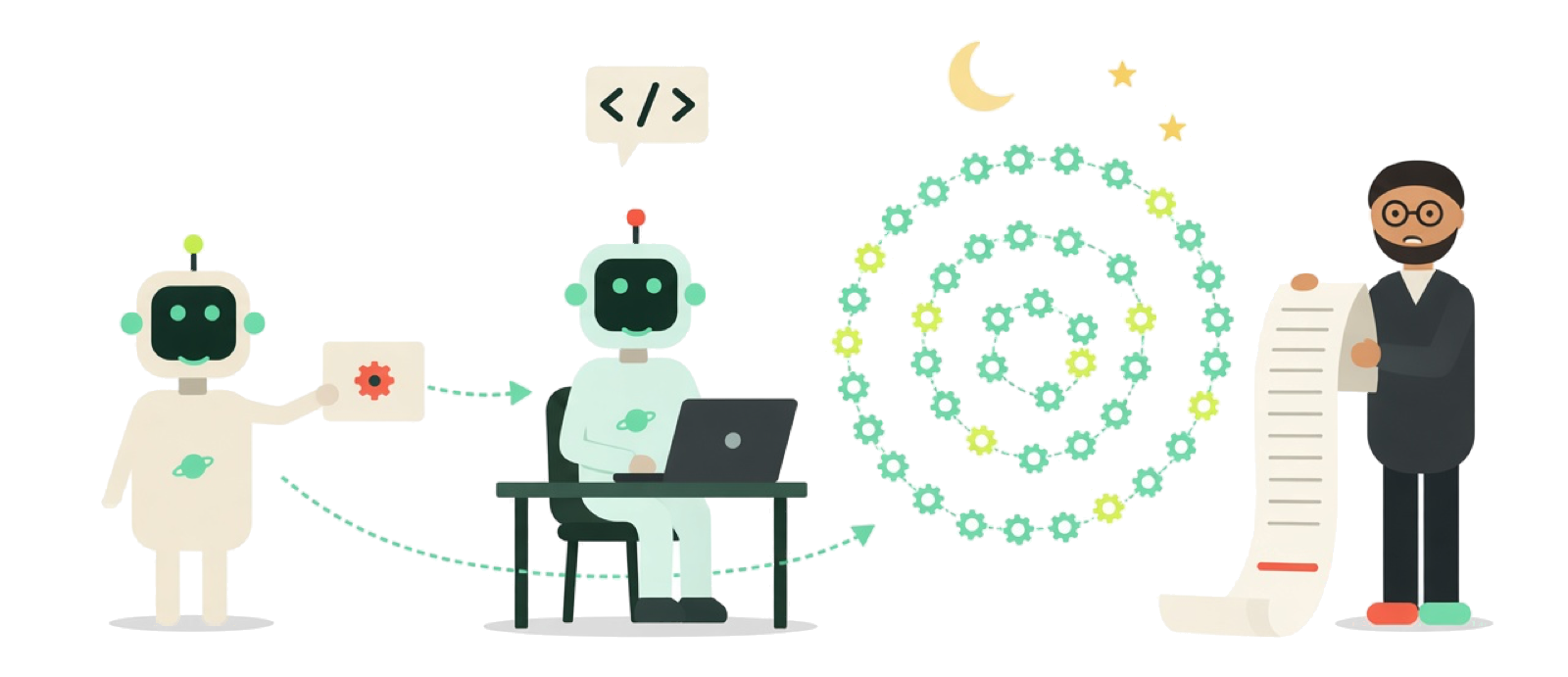
Sometime soon, a team will open its cloud bill and find a line nobody remembers approving. One agent needed a small converter. A second agent wrote it. The first one ran it forty thousand times overnight. Every step worked. No person asked for any of it, and the invoice still has a person's name on it.
That isn't science fiction. Every piece of that night is already running somewhere. This series is about what it means.
For most of my career, I wrote software for people. I wrote it for the user clicking a button, and for the teammate who would maintain it next month. Both of them could ask questions, figure out what I meant, and notice when something looked off.
That is changing fast. AI writes a lot of my code now, and everyone talks about that part. Fewer people notice the other change: who the code is for. More and more, it is written for another AI.
The coder and the client
Every software project used to have three roles, and people played all of them. Someone asked for it. Someone built it. Someone paid.
The first two are moving to machines. An agent is working on a task and hits a gap: it needs a script, a connector, a small piece of code that doesn't exist yet. So it asks for one. Another agent writes it. The first agent runs it, decides it is good enough, and moves on. Sometimes it is the same model on both sides. Sometimes it is two agents that were never introduced. Either way, the coder is an AI and the client is an AI.
No person wrote the request. No person read the code.
I already see this in my own work: tests written by AI and checked by AI, and helpers one agent picked from a list another agent helped build.
Why it keeps speeding up
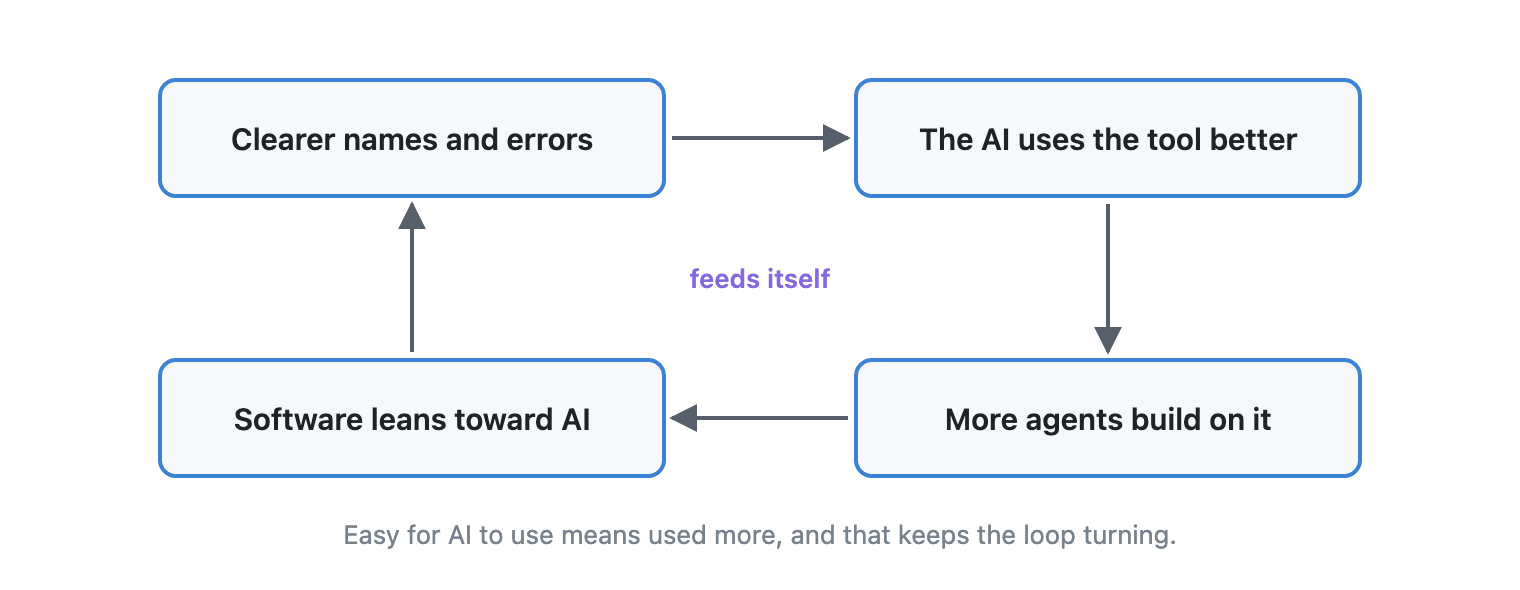
Code that is easy for an AI to read and call gets used more. So we write more of it that way: clearer names, plainer instructions, error messages that say what to do next. More agents build on top of it, and the next piece of code gets written with an AI reader in mind. Over time, software leans toward machines. Nobody planned that. It is where the incentives point.
The role that hasn't moved
The third role is still ours. Somebody pays: the compute, the subscriptions and the cloud bill at the end of the month all carry a person's name. And somebody lives with the result: the customer waiting for a reply, the team that depends on code nobody read.
The AI can be the coder and the client. A person is still the one who pays, and the one who lives with the result.
Half of that role may move too. Someday an agent may earn its own money, by selling data or running its own YouTube channel, and pay its own bills. Even then, a person lives with the result. That's a different series. For now, the bill has a person's name on it.
If an agent on your team can ask another agent for code and accept it, who is the person who signs off? Or is there one? Tell me on LinkedIn.
A client that is an AI reads every word literally. It doesn't skim, it doesn't ask a follow-up question, and it doesn't use common sense unless somebody wrote that common sense down.
Cheers,
Markus
No bug 🐛 too small, no syntax too weird 🔍 🧐 🔨 🦾