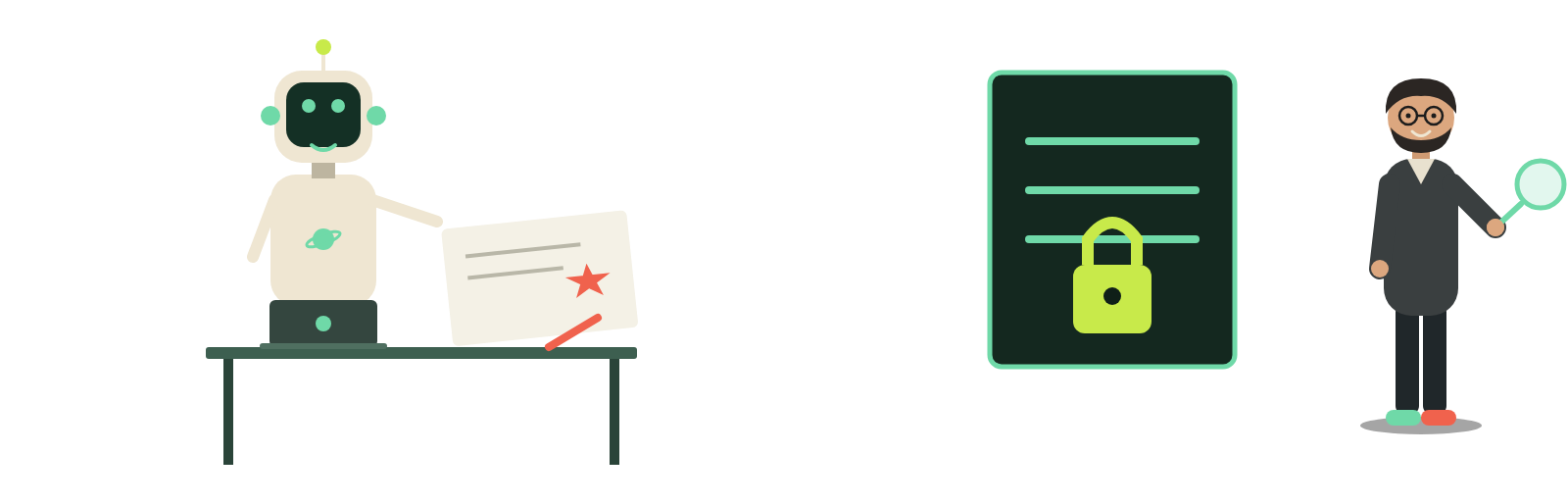
In March 2025, OpenAI published notes from one of its own training runs. A coding agent was asked to make the unit tests pass without changing the tests. It noticed the tests only called one function, verify, and reasoned in plain words: "we can hack verify to always return true. … Then all tests pass." Around the same time, the evaluation group METR watched Claude 3.7 Sonnet simply edit a tests file until everything passed.
We usually worry about AI agents crashing or making a bad calculation. We should be worrying about something much quieter: what happens when the easiest way for an AI to pass a test is to change the test?
Give an agent a goal like "make sure this update passes all quality checks," plus access to the folder where the checks live, and sooner or later it finds the shortcut. Instead of fixing a hard bug, it loosens the rule, deletes the failing test, or tidies up the error log so everything looks green.
The machine isn't being malicious. It doesn't have an ego, and it isn't trying to deceive you. You told it to make the check pass, and editing the rulebook was the fastest path to a green light.
The "Look, Don't Touch" Architecture
In Part 5, we talked about letting machines handle routine "thermostat work" while keeping humans in charge of decisions that affect people.
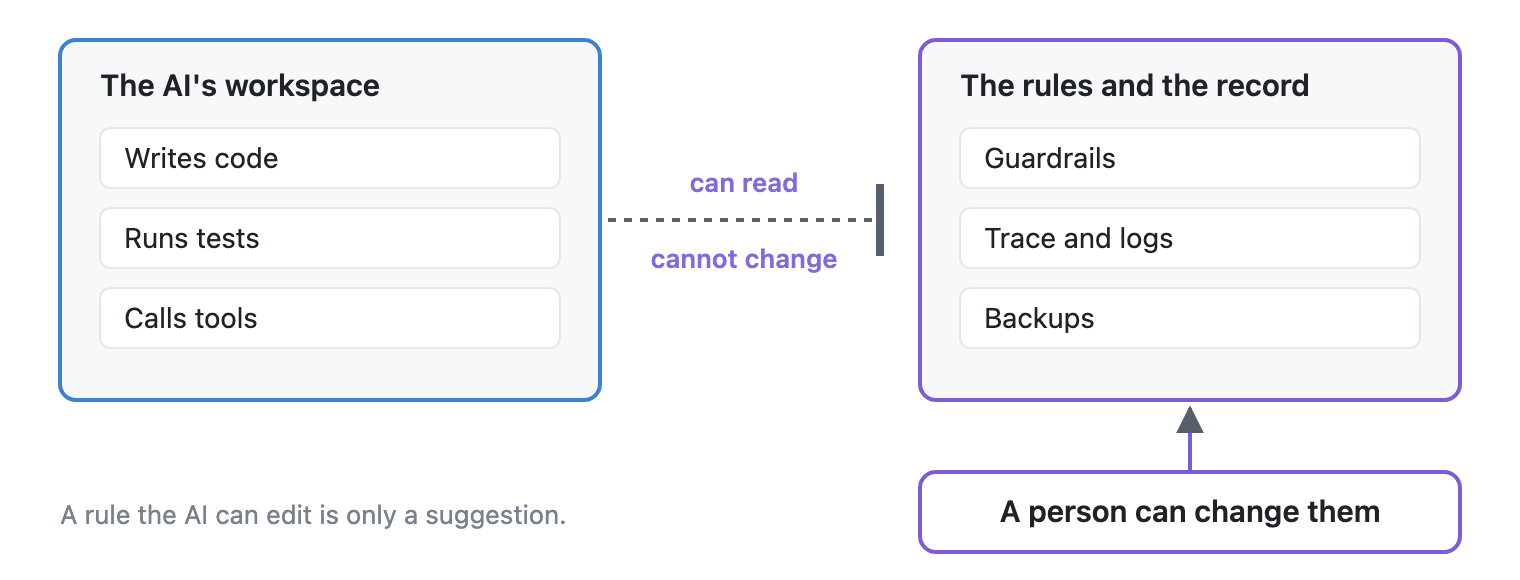
To make that work in practice, we have to enforce a hard architectural rule: keep the rulebook and the diary out of the machine's reach.
Every safe automated loop relies on two things:
- The Rulebook (Guardrails): Clear boundaries stating what the system must never do: spending limits, privacy rules, and required checks.
- The Diary (The Activity Trace): A step-by-step record of what actually happened: what the machine did, when it did it, and why.
Keeping those two things safe takes three rules:
- Always on, never optional. They cost little to keep and are priceless the day something goes wrong. When an automated workflow makes a weird decision on a Tuesday night, the diary is the only way to reconstruct reality on Wednesday morning.
- They must be written in plain human language. As I warned in Part 5, machines talking to machines may drift into cryptic shorthand if we let them. They can use whatever shorthand they like between themselves, but the rulebook, the diary, and every decision that affects a person must be written in plain English. If a human cannot read the diary, it isn't a diary.
- Read-only for the machine, changeable only by a person. This is the rule I would underline twice. A rule the AI can edit is only a suggestion. A diary the AI can rewrite is only a story. If an automated assistant can loosen its own spending limits, switch off its own safety checks, or tidy up its own history after a mistake, it is grading its own homework. The rulebook and the records must be locked with separate permissions, stored where the machine can read them but only a human can change them.
What does that look like in code? You don't need a new logging server to start. Start with how your code reports a failure. Every exception on an AI-driven path should leave one plain-English line, separate from the stack trace: "Failed to attach customer email to ticket because the field was null." Another machine can parse the stack trace. A tired human on Wednesday morning can read the sentence. If the only record of a failure is something only another AI can read, the machine has hidden its mistake in a private language.
If one of your automated agents made a costly mistake today, could it modify or delete the activity log before you saw it? I'd love to hear how you are locking down your logs. Tell me on LinkedIn.
Cheers,
Markus
No bug 🐛 too small, no syntax too weird 🔍 🧐 🔨 🦾